
Introduction
Transforming from understanding the definitions of anesthesia to its clinical execution reveals a crucial reality. Safe anesthesia does not begin when an anesthetic drug enters the bloodstream. Instead, it begins long before the patient enters the operating room. Pre-Anesthetic Evaluation provides the foundation for perioperative care. It creates a systematic bridge between overall patient health and individualized surgical management.
While laypersons may view anesthesia as a simple state of medically induced sleep, anesthesia professionals understand its complexity. It requires precise control of pharmacology, airway dynamics, and physiological function. Identifying patient-specific risks, tailoring drug selection, and anticipating complications are essential before induction. This comprehensive guide explores preoperative assessment, risk stratification, fasting protocols, and medication management.
Understanding the Pre-Anesthetic Assessment
The primary objective of the pre-anesthetic assessment is to evaluate a patient’s medical status, optimize controllable systemic conditions, and formulate an appropriate anesthetic plan, Beyond clinical data collection, this interaction establishes vital rapport, alleviate patient anxiety, and enables informed consent.
Pre -Anesthetic Evaluation
Clinical History
- Medical and surgical history
- Anesthetic history
- Allergies
Physical Exam
- Airway check
- Cardiopulm
- Vital signs
Diagnostic Check
- Labs/ECG
- Radiographs
- Functional
Comprehensive Medical History
A thorough patient history provides the foundation for risk mitigation. The anesthesia provider systematically investigates several core domains:
- Active and Past Medical Conditions:
Detailed inquires into cardiovascular function (hypertension, ischemic heart disease, heart failure), respiratory health (asthma, COPD, obstructive sleep apnea), renal function, liver disease and endocrine disorders (such as diabetes mellitus and thyroid dysfunction).
- Previous Surgical and Anesthetic
Identifying past adverse reactions, delayed emergence, severe past-operative nausea and vomiting or difficult airway management during previous operations.
- Family Anesthetic history
Uncovering hereditary conditions that pose severe risks under general anesthesia , such as Malignant Hyperthermia – a life threatening hypermetabolic reaction triggered by volatile anesthetics and succinylcholine or pseudocholinesterase deficiency, which causes prolonged neuromuscular blockade.
- Allergies and Adverse Reactions Differentiating between true IgE-mediated allergic reactions (e.g to latex, neuromuscular blocking agents, or antibiotics) and common pharmacological side effects.
Targeted Physical Examination
The physical exam focusses on organ systems most impacted by anesthetic agents:
- Airway Assessment: Airway evaluation is critical for anticipating difficult mask ventilation or tracheal intubation. Providers assess several specific parameters:
- Mallampati classification; classifying the visual visibility of pharyngeal structures (tongue, soft palate, uvula) with the mouth open wide
- Thyromental Distance: The distance between the thyroid notch and the mentum(chin), where less than 6cm suggests a potentially difficult laryngoscopy.
- Mouth Opening and Neck Mobility: Ensuring adequate inter-incisor distance (at least 3 fingerbreadths) and cervical spine extension.
- Cardiopulmonary Assessment:
Auscultation of heart and lung sounds to detect murmurs, arrythmias, wheezing, or rales, paired with baseline vital sign verification.
ASA Physical Status Classification System: A Complete Guide to Patient Risk Stratification
To standard patient health assessment across institutions, the American Society of Anesthesiologist created the ASA physical status classification system. This system categorizes a patient’s physiological reserve and overall operative risk.
ASA Class, Description and Clinical Example
- ASA I
A normal, healthy patient
Non-smoker, a organic or physiological disease.
- ASA II
A patient with mild systemic disease without functional limitations
Controlled hypertension, well-controlled diabetes, mild asthma, current smoker
- ASA III
A patient with severe systemic disease with functional limitations
Uncontrolled diabetes, stable angina, COPD, morbid obesity (BMI ≥ 40)
- ASA IV
A patient with severe systemic disease that is a constant threat to life
Recent MI (< 3 months), ongoing cardiac ischemia, severe valve dysfunction, sepsis
- ASA V
A moribund patient who is not expected to survive without the operation
Ruptured abdominal aortic aneurysm, massive head trauma, ischemic bowel
- ASA VI
A declared brain-dead patient whose organs are being harvested
Organ donor recipient preparation
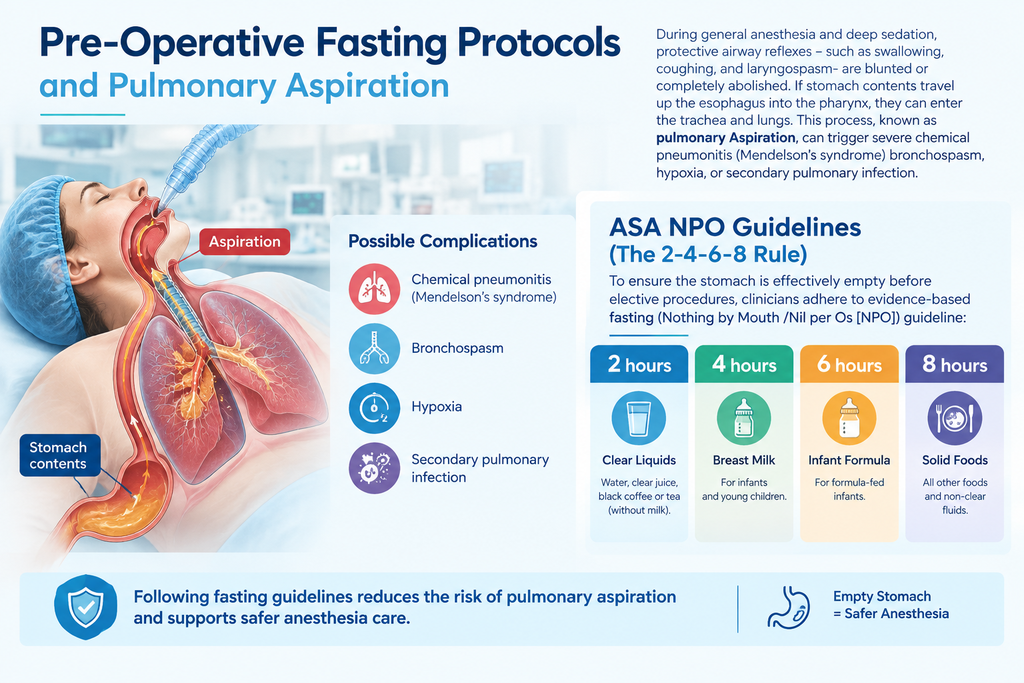
Pre-Operative Fasting Protocols and Pulmonary Aspiration
During general anesthesia and deep sedation, protective airway reflexes – such as swallowing, coughing, and laryngospasm- are blunted or completely abolished. If stomach contents travel up the esophagus into the pharynx, they can enter the trachea and lungs. This process, known as pulmonary Aspiration, can trigger severe chemical pneumonitis (Mendelson’s syndrome) bronchospasm, hypoxia, or secondary pulmonary infection.
ASA NPO Guidelines (The 2-4-6-8 Rule)
To ensure the stomach is effectively empty before elective procedures, clinicians adhere to evidence-based fasting (Nothing by Mouth /Nil per Os [NPO}) guideline:
- 2 hours: Clear liquids (water, fruit juice without pulp, clear tea, black coffee without dairy)
- 6 hours: non-Human milk, infant formula, and light meal (e.g dry toast and clear liquids)
- 8 hours or More: Heavy, fatty, or fried foods and meat, which significantly delay gastric emptying.
Conditions Requiring Extended Fasting or Special Care
Certain medical conditions slow gastric motility, increasing baseline aspiration risk even when fasting rules are followed:
- Gastroparesis (common in long-standing diabetes mellitus).
- Gastroesophageal Reflux Disease (GERD) or hiatal hernia.
- Pregnancy (due to elevated progesterone and mechanical pressure from the uterus).
- Trauma, acute pain, or opioid consumption.
- Treatment with GLP-1 receptor agonists (e.g semaglutide), which delay gastric emptying and require tailored pre-op holding protocol.
- Treatment with GLP-1 receptor agonists (e.g., semaglutide), which delay gastric emptying and require tailored pre-op holding protocols.
Pre-Operative Medication Management
Managing daily medications prior to surgery requires balancing the risk of stopping a chronic therapy against the risk of drug interactions with anesthetic agents.
Medications to Continue
Most essential maintenance medications are continued on the morning of surgery with a tiny sip of water:
Cardiovascular Medications: Beta-blockers and statins are maintained to protect against perioperative myocardial ischemia.
Anti-Seizure Medications: Maintained to prevent breakthrough seizures in the perioperative window.
Thyroid Hormones & Inhaled Steroids: Continued as scheduled.
Medications to Hold or Adjust
ACE Inhibitors and ARBs: Frequently held 12–24 hours prior to surgery to prevent refractory hypotension during anesthetic induction.
Anticoagulants and Antiplatelets: Blood thinners (e.g., warfarin, clopidogrel, DOACs) are held according to specific timelines to minimize surgical bleeding and permit neuraxial anesthesia (epidurals/spinals). Bridging therapy with heparin may be used for high-risk patients.
Diabetes Medications: Oral hypoglycemics are typically held on the morning of surgery. Short-acting insulin is withheld while long-acting insulin doses are adjusted to reflect fasting status.
Herbal Supplements: Stopped 1–2 weeks prior to elective surgery due to antiplatelet effects (garlic, ginkgo, ginseng), cardiovascular instability (ephedra), or sedation prolongation (St. John’s wort, valerian).
Day-of-Surgery Protocols & Patient Reassurance
On the day of the procedure, the pre-op workflow transitions into execution:
Pre-Op Holding Routine: The care team re-verifies patient identity, confirms NPO adherence, secures intravenous (IV) access, and checks baseline vital signs. Pre-medications, such as anxiolytics (e.g., midazolam) or antiemetics, may be administered.
The Surgical “Time-Out”: Immediately prior to induction, the surgical team, nurse, and anesthesia provider conduct a standardized verification step to confirm patient identity, consent, procedure, surgical site, and equipment readiness. Managing Patient Anxiety: Clear communication regarding what to expect reduces sympathetic activation, stabilizing baseline heart rate and blood pressure before induction.
VII. Conclusion
The pre-anesthetic evaluation turns potentially unpredictable intraoperative events into a structured, highly controlled process. Through patient history taking, physical examination, ASA risk scoring, strict fasting adherence, and drug management, the anesthesia care team minimizes perioperative risk. Clear communication and complete patient transparency during this evaluation remain the single most effective safeguard in modern anesthesia practice.
Table of Contents
Q1: What happens if I accidentally eat or drink something during my required fasting window?
You must inform your anesthesia provider immediately. Depending on what and when you ate, your surgery may be delayed by a few hours to allow your stomach time to empty, or rescheduled for another day if it is an elective procedure. Concealing food intake significantly increases the risk of severe pulmonary aspiration during surgery.
Q2: Can I take my usual morning medications with water on the day of surgery?
Most essential medications—such as those for blood pressure, heart rhythm, or seizures—should be taken on the morning of surgery with a tiny sip of water. However, specific medications like blood thinners, diabetes drugs, and ACE inhibitors must be held or adjusted. Always follow the explicit instructions provided during your pre-anesthetic evaluation.
Q3: How does the anesthesia team assess if my airway will be difficult to manage?
During your pre-op exam, the anesthesia provider will ask you to open your mouth wide and stick out your tongue (the Mallampati test), evaluate the distance between your chin and neck, and check your neck flexibility. These simple physical checks help predict how easily a breathing tube or mask can be placed and allow the team to prepare specialized equipment in advance if needed.
Q4: Why is it important to tell my anesthesiologist about herbal supplements or recreational drug use?
Herbal supplements (like garlic, ginkgo, and St. John’s wort) can cause unexpected bleeding or prolong the sedative effects of anesthetic agents. Similarly, recreational substances, alcohol, and tobacco directly alter how your body metabolizes anesthetic drugs and affects your heart and lungs. Anesthesia teams operate under strict confidentiality; sharing this information is purely for your safety.
Leave a Reply